Convert Png To Jpg
Convert PNG To JPG file while preserving quality. Our privacy-focused tool works right in your browser—no uploads, no watermarks.
Drag & Drop Your PNG Files Here
or click anywhere to browse
Max 10 files, 30MB each
Png To jpg converter Online For Free
A PNG to JPG converter is a tool that converts images from the PNG (Portable Network Graphics) format to the JPG (Joint Photographic Experts Group) format. Since PNG supports transparency and JPG does not, converters often fill transparent areas with a solid color (usually white).
JPG is a lossy format, meaning it reduces file size by compressing image data (unlike PNG, which is lossless).
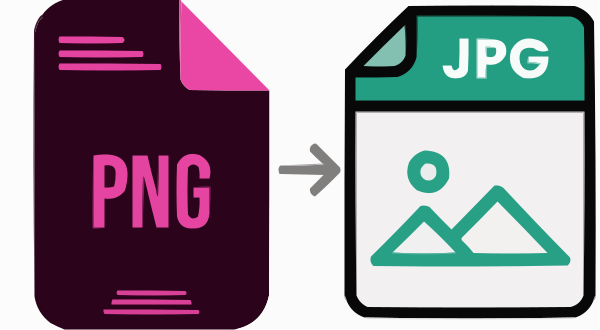
Convert Png To Jpg — Fast & Secure
Everything you need to convert your images quickly and securely.

Privacy Protected
Your images are processed in your browser and never uploaded to our servers. Your privacy is 100% guaranteed.
First Process
Our tool processes images directly in your browser for lightning-fast convert without waiting in queues.
Batch Processing
Upload and convert multiple images at once. Save time by processing your entire image collection in one go.

File Transfer Encryption
All file transfers are encrypted for maximum security, ensuring your images remain private and protected.

It's Free For All
No hidden costs, no watermarks, no registration required. Our png to jpg converter is completely free to use for everyone.

Mobile Friendly
Optimized for all devices. Convert images on your phone, tablet, or desktop with the same great experience.
The Ultimate Guide to Convert PNG to JPG: Everything You Need to Know
In the expansive and ever-evolving digital world of web design, digital photography, graphic art, and everyday content creation, image formats play a foundational role. Among the dozens of formats available, two reign supreme in popularity: PNG and JPG (or JPEG). If you have ever worked with images on a computer, you have undoubtedly encountered both. While both formats serve the purpose of displaying visual media, they are built entirely differently under the hood. There are numerous scenarios where you might need to convert PNG to JPG to shrink file sizes, improve website loading speeds, or meet strict file upload requirements on various platforms.
This comprehensive, 2000-word guide is designed to walk you through everything you need to know about these two titan image formats. We will explore the technical differences between them, the precise reasons why you would want to convert a lossless PNG to a lossy JPG, how the conversion process works mathematically and practically, and the best use cases for each format. Whether you are a seasoned web developer looking to optimize site load times, a graphic designer handing off deliverables, or an everyday user trying to email a large image without hitting attachment limits, understanding how to convert PNG to JPG is an essential digital skill.
Understanding the Basics: What is a PNG?
Before diving into the reasons why you should convert PNG to JPG, it is crucial to understand what a PNG actually is. PNG stands for Portable Network Graphics. Developed in the mid-1990s as an open-source alternative to the heavily patented GIF format, PNG was specifically designed for transferring graphics over the internet. PNG utilizes what is known as "lossless" compression. This means that when an image is saved as a PNG, absolutely no visual data is lost. You can open, edit, and save a PNG thousands of times, and the image quality will remain exactly as pristine as the day it was created.
Because PNG files retain all original image data, their file sizes are generally significantly larger than other formats, especially when dealing with complex, multi-colored photographs. However, PNGs excel in areas that require precision. Because they do not use block-based lossy compression, PNGs are incredibly sharp. They are perfect for images containing text, line art, blueprints, graphics with stark transitions between colors, and detailed logos.
Most importantly, the PNG format supports an "alpha channel." In digital imaging, an alpha channel represents the degree of transparency (or opacity) of a color. This allows PNG files to have fully transparent backgrounds, or even partial transparency (like a drop shadow that smoothly fades into whatever background it is placed over). However, this incredible amount of detail and utility comes at the cost of massive file sizes, which is exactly why users often seek out ways to convert them.
Understanding the Basics: What is a JPG?
On the other side of the digital spectrum, we have the JPG. JPG stands for Joint Photographic Experts Group, which is the name of the committee that created the standard in the early 1990s. The JPG format was revolutionary because it introduced a method of compressing digital images to make their file sizes significantly smaller, allowing them to be easily stored on the limited hard drives of the era and transmitted over slow connections.
JPG relies on what is known in computer science as "lossy" compression. This means that when an image is saved as a JPG, the algorithm actively discards "unnecessary" visual data to reduce the overall file size. It does this by analyzing blocks of pixels and grouping similar colors together. To the human eye, a high-quality JPG looks nearly identical to the original uncompressed image, but the file size can be reduced by up to 90%. This makes JPG the undisputed king of digital photography and general web imagery.
While JPG does not support transparent backgrounds (transparent pixels are automatically replaced with a solid color, usually white), its unparalleled ability to compress complex, high-color photographs into manageable, bite-sized files makes it an absolute necessity in web development and daily digital life.
Why Should You Convert PNG to JPG?
If PNG provides flawless, lossless quality, why do millions of people search for ways to convert PNG to JPG every single day? The decision to switch from PNG to JPG usually boils down to three primary factors: drastically reducing file size, improving web performance, and strict software or platform compatibility.
1. Dramatic File Size Reduction
By far, the most common reason people use a tool to convert PNG to JPG is to shrink the physical footprint of an image file. Because PNG is lossless, it stores data for every single pixel. If you have a massive, high-resolution photograph saved as a PNG, the file size can easily exceed 20 to 30 Megabytes. This makes it incredibly difficult to attach to emails, share via messaging apps, or upload to cloud storage without eating up your bandwidth and storage quotas.
By converting that exact same photograph to a JPG, the lossy compression algorithm takes over. It groups similar pixels and selectively discards redundant data. The result is an image that looks almost completely identical to the human eye, but the file size will plummet from 30 Megabytes down to perhaps 2 or 3 Megabytes. This 90% reduction in size makes the JPG format infinitely more practical for everyday sharing and storage.
2. Optimizing Web Performance and SEO
If you are a webmaster, a blogger, or an SEO specialist, you know that website loading speed is paramount. Google and other search engines actively penalize websites that take too long to load. Furthermore, human users are notoriously impatient; if a page takes more than three seconds to load, bounce rates skyrocket.
Uploading massive PNG photographs to your website is one of the fastest ways to destroy your load times. A single 10MB PNG hero image can completely stall a webpage on a mobile 4G connection. By opting to convert PNG to JPG before uploading images to your server, you ensure that your visual assets are lightweight. This leads to blazing-fast page loads, happier users, better engagement metrics, and ultimately, higher rankings in search engine results pages (SERPs).
3. Removing Unwanted Transparency
Sometimes, transparency isn't a feature; it's a bug. If you have a graphic with a transparent background but you need it to be displayed on a stark white background, dealing with the PNG alpha channel can be frustrating. Furthermore, some legacy software systems, older printing hardware, and specific online application portals simply do not know how to handle transparent PNG files correctly, often rendering them with ugly black borders or entirely black backgrounds.
When you convert PNG to JPG, you forcefully flatten the image. Because JPG does not support alpha channels, the conversion process will automatically fill the transparent areas with a solid color (usually a clean, solid white). This guarantees that the image will look exactly the same across every possible device, screen, and printer on earth.
4. Strict Platform Upload Limitations
Many government websites, academic portals, passport photo uploaders, and legacy corporate systems have extremely strict technical requirements for uploading files. Frequently, these systems explicitly state: "Only .JPG or .JPEG files accepted" or "Maximum file size 2MB." If you only have a massive PNG file, you are essentially locked out of the system. Using our browser-based tool allows you to instantly convert PNG to JPG, ensuring your document or photograph meets the strict criteria of these legacy systems.
How Does Our Client-Side Convert PNG to JPG Tool Work?
The tool provided at the top of this page represents the modern standard of web applications. In the past, if you wanted to convert PNG to JPG, you had to upload your private images to a remote server. The server would process the file using backend software and then send the converted file back to you for download. This older method presented significant privacy risks, required massive bandwidth, and was frustratingly slow for users on weak connections.
Our tool changes the paradigm entirely by leveraging the power of HTML5 and modern JavaScript directly within your internet browser. Here is exactly what happens when you use our drag-and-drop tool to convert PNG to JPG:
- File Selection: When you drag and drop your PNG files (up to 10 at a time, up to 30MB each), your browser securely reads the file data into its local memory.
- Canvas Rendering: The JavaScript code takes your PNG image data and essentially "draws" it onto an invisible HTML5 Canvas element running in the background of the web page.
- White Background Fill: Crucially, before the PNG is drawn, the tool fills the invisible canvas with a solid white block. This ensures that any transparent areas in your PNG become pristine white in the final JPG, rather than turning an ugly glitchy black.
- Local Conversion: Once the image is drawn, the browser utilizes its native APIs to compress and export that canvas data as a brand new "image/jpeg" file at high quality (typically 90-92% quality to balance size and clarity).
- Instant Download: The tool then creates a secure, temporary URL pointing to this newly created JPG blob in your browser's memory, generating the "Download JPG" button for you instantly.
Because this entire process happens strictly within the confines of your device's browser (client-side), your images are never uploaded to our servers. This guarantees 100% privacy and security for your sensitive documents, personal photographs, and proprietary business graphics. It also means the conversion is lightning fast, limited only by the processing speed of your own computer or smartphone, rather than our server traffic.
Step-by-Step Guide: How to Convert PNG to JPG Using This Tool
We have designed the user interface to be as frictionless as possible. Even if you have no technical experience, you can convert PNG to JPG in seconds by following these simple steps:
Step 1: Locate your PNG files. Ensure the images you want to convert are saved on your device (computer, tablet, or smartphone). Remember that this tool allows you to process up to 10 files simultaneously, making it great for batch conversions.
Step 2: Drag and Drop. Simply click and drag your PNG files from your desktop or folder and drop them into the dashed box above that says "Drag & Drop your PNG files here". Alternatively, if you are on a mobile device, just tap the box to open your phone's photo gallery and select your images.
Step 3: Automatic Conversion. Once the files are selected, the tool immediately begins the conversion process. You don't even need to click a "start" button. The tool automatically checks to ensure the files are valid PNGs, fills in any transparency with white, and applies JPG compression.
Step 4: Download your JPGs. Within milliseconds, a list of your processed files will appear below the drop zone. You will see the original file name, the newly reduced file size, and a green "Done" badge. Simply click the blue "Download JPG" button next to each file to save the perfectly converted JPG directly to your device.
Best Practices for Image Optimization on the Web
While knowing how to convert PNG to JPG is an incredibly useful skill, knowing when to use which format is what separates average web users from professional developers and digital marketers. Using the wrong image format can bloat a website's page size, significantly increasing load times, ruining the user experience, and negatively impacting Google Search Engine Optimization (SEO) rankings.
When you MUST Convert PNG to JPG
You should almost always convert your files to JPGs for large, complex photographs where exact pixel-perfect fidelity is not strictly required. If you have a massive PNG photo gallery of a recent vacation, product photography for an e-commerce store (assuming they don't require transparent backgrounds), or large hero background images for a website, converting them to JPG is your best move. The lossy compression will keep your webpage lightweight and fast. Using a PNG for a complex photograph is a massive waste of bandwidth.
When to Stick With PNG
Conversely, you should keep your files in PNG format (or convert back to it) in the following scenarios:
- Images with transparency: As stated, this is the most common reason. Drop shadows, cut-out subjects, and layered graphics require the alpha channel that only PNG provides.
- Logos and Brand Icons: Because these require crisp edges and often need to sit on various colored backgrounds without a white bounding box.
- Screenshots containing UI elements: PNG prevents the text and buttons within the screenshot from becoming blurry with JPG compression artifacts.
- Web Graphics and Illustrations: Digital art, flat design illustrations, and vector-style graphics exported to raster formats should remain PNGs to preserve solid color blocks cleanly without blocky artifacts.
Comparing Image Formats: PNG vs. JPG vs. WebP
As technology advances, new formats emerge. While the debate usually centers around whether to convert PNG to JPG, we must also acknowledge newer next-generation formats like WebP. Developed by Google, WebP aims to be a master-of-all-trades format. It supports both lossy compression (like JPG) and lossless compression (like PNG), and it supports transparency.
WebP files are generally 25-35% smaller than their equivalent JPGs or PNGs. Because of this, many modern websites are transitioning to WebP. However, JPG and PNG remain the universally dominant legacy formats. Every single piece of software, operating system, and legacy browser on earth fully supports JPG and PNG. Sometimes, downloading a WebP image can be frustrating because older desktop image viewers or specific desktop publishing software might not know how to open it. In these instances, users often find themselves needing to convert WebP back to JPG for compatibility.
Therefore, knowing how to convert PNG to JPG remains a vital bridge for ensuring universal compatibility, especially when handing off design assets to printers, clients, or older software ecosystems.
Conclusion
Understanding image formats is a subtle but incredibly important aspect of modern digital literacy. While PNG is the undisputed champion of pristine quality, transparency, and sharp graphic design, JPG will likely forever remain the king of everyday digital photography and web optimization due to its highly efficient file sizes. Knowing exactly when to use each format allows you to create faster websites, share photos more easily, and bypass restrictive upload limits.
Whether you are trying to free up hard drive space, speed up your WordPress blog, or submit documents to a strict online portal, the ability to quickly and securely convert PNG to JPG is an indispensable tool in your digital arsenal. Our free, secure, in-browser tool is designed to make this process as fast and frictionless as possible, without compromising your privacy or data security. Bookmark this page for the next time you encounter an image file size dilemma!
Convert Png To Jpg in 3 Simple Steps
Convert png to jpg file without sacrificing quality—drag, adjust, download.
Upload Images
Click the "Select Files" button or drag and drop your PNG images into the upload area. You can select multiple files at once for batch processing.
Adjust Settings
Our png to jpg converter processes images automatically without significantly affecting its visual quality, using advanced algorithms.
Convert & Download
When images upload is complete wait a few seconds. Once processing is complete, download your converted images individually or all at once.
Frequently Asked Questions
Find quick answers to common questions about our Png To Jpg Converter
What happens to the transparent background in my PNG?
Because the JPG format inherently cannot support transparency, any transparent pixels in your original PNG must be given a color. Our client-side conversion tool automatically places a solid white background behind your image before converting it to JPG. This ensures your image looks clean and professional, rather than defaulting to an ugly black background.
Will converting PNG to JPG ruin the image quality?
For standard viewing, no. While JPG is a "lossy" format (meaning it discards some data to save space), high-quality JPG compression is virtually indistinguishable from a PNG to the naked human eye. Our tool exports your JPGs at a high-quality preset, ensuring you get the benefit of a massively reduced file size without noticeable degradation or blocky artifacts.
Why did my file size decrease so much?
This is the magic of JPG compression! PNG files store data for every single pixel, making them huge. JPG algorithms look for patterns and group similar colors together, throwing away redundant data. This is exactly why you convert PNG to JPG: to save massive amounts of hard drive space and bandwidth.
Is it safe to use this online converter?
Absolutely. As detailed in the 'How It Works' section, our tool utilizes client-side JavaScript technology. This means the script runs locally on your machine. Your PNGs never leave your device, they are never uploaded to a remote server, and we do not store or see your images. It is 100% private and safe for highly sensitive or confidential documents.
Does this tool support batch conversions?
Yes! To save you time, our tool allows you to drag and drop up to 10 PNG files simultaneously. The script will rapidly process all of them one by one, providing you with individual download links for your new, lightweight JPGs.